
Inside the Kit: The Gear Behind Night Shift
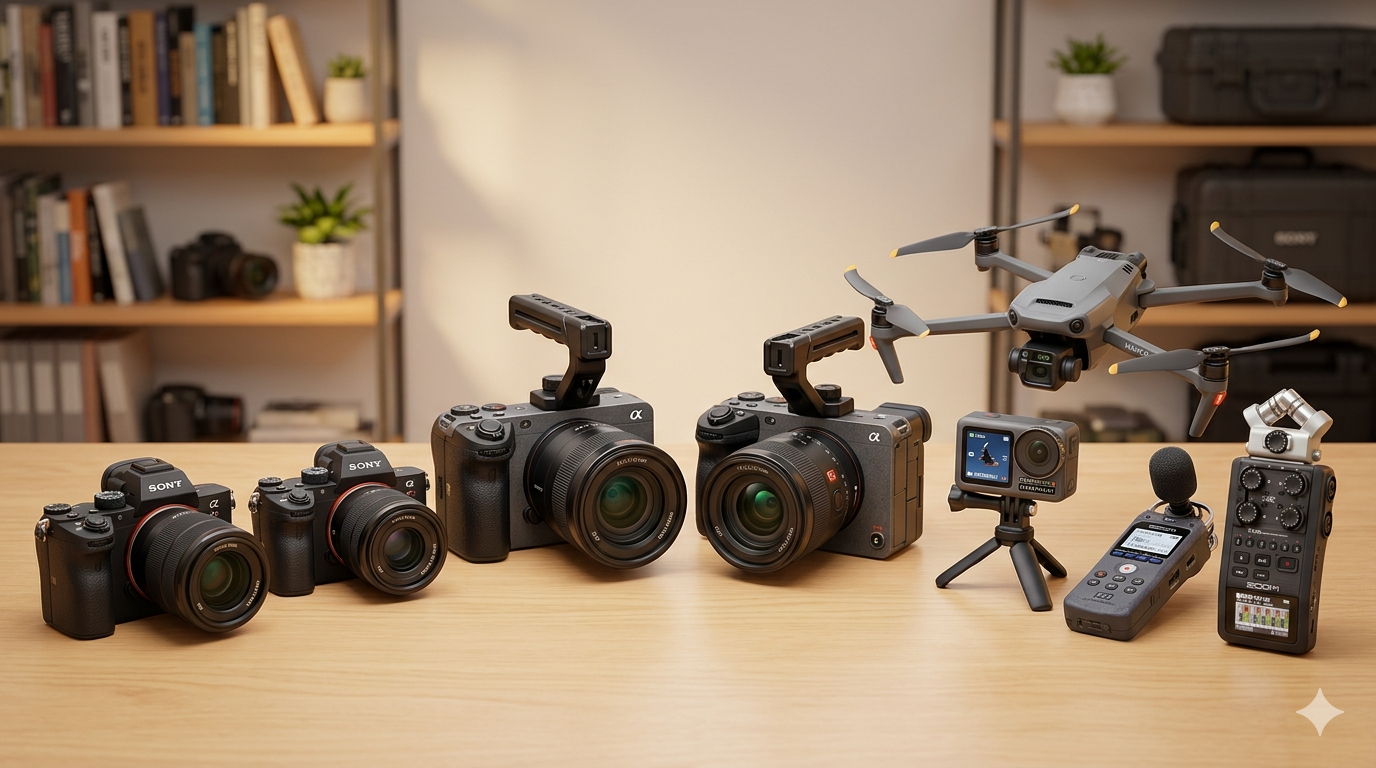
There’s a reason we say we don’t just toss up a few GoPros.
The look of a set — the depth in the shadows, the clean motion, the way a drop actually hits on screen — comes down to using the right tool for each job and knowing how to push it. Here’s what we shoot with, what we use it for, and why it matters for how your night ends up looking.
Cinematic Full-Length Sets
The backbone of a full-length YouTube set is image quality that holds up in the worst lighting a venue can throw at it: hard strobes, deep blacks, colored haze, and almost no usable ambient light.
That’s where the Sony FX3 lives. It’s a full-frame cinema camera built for low light. Dual base ISO helps it stay clean when the room goes dark and explode back to life on the drops, instead of turning into a noisy mess.
It’s our hero angle: the wide, locked, cinematic frame that anchors the whole edit.
We pair it with the Sony FX30, a Super 35 cinema body that gives us a second true cine angle — tight crops, over-the-shoulder behind-the-decks shots, and detail angles that cut seamlessly against the FX3.
Together, those two cinema bodies let the full-length set keep a consistent, premium look every time we switch angles.
Multicam Clips for Socials
Short-form is where the gear count earns its keep.
The more clean angles we capture live, the more the editor has to work with — and the more one set can turn into a full week of content.
On top of the FX3 and FX30, we run the Sony A7 IV and Sony A7C as additional video angles. The A7C is compact and discreet, which makes it perfect for tight booths, roaming crowd shots, and positions where a larger rig would get in the way.
Stacked together, four angles let us cut fast, energetic clips that match the pace of the music instead of relying on the slow, flat single-angle footage most artists end up posting.
Cinematic Movement
Locked-off angles tell part of the story. Movement tells the rest.
To get smooth, deliberate motion instead of shaky handheld footage, we run two of DJI’s newest stabilization systems.
The DJI RS 5 is our primary gimbal for cinematic moving shots: slow push-ins on the artist, sweeping booth moves, and dynamic b-roll that gives the edit energy. We also use intelligent tracking to help keep the artist framed as they move around the decks, even during fast, unpredictable performances.
For tighter spaces and run-and-gun moments, the DJI RS 4 Mini gives us stabilized motion in a smaller, faster package — ideal for weaving through a crowd or grabbing a shot quickly without disrupting the flow of the night.
The point is simple: smoother motion makes the final content feel intentional, cinematic, and professional.
Photography
A great set deserves great stills — not screen grabs.
The Sony A7 IV doubles as our primary photo body, delivering full-frame detail that holds up everywhere from Instagram carousels to press kits, flyers, and posters.
We focus on the moments that sell a show: hands up, lasers cutting through haze, the artist locked in behind the decks, and the crowd reacting at the exact right second.
These are the frames that become your next announcement, recap post, flyer, or press asset.
Aerials, Establishing Shots, and B-Roll
For festivals, rooftops, and outdoor events, the DJI Mavic 4 Pro gives us scale you simply can’t get from the ground.
A clean aerial pullback over a packed crowd is the kind of shot that makes a show feel huge. It instantly communicates the size of the moment and gives long-form edits a true sense of place.
Beyond the big aerials, we use drone footage for cinematic b-roll — slow moves over the venue, skyline, crowd, or line out front — that can be woven throughout the final edit.
Outdoors and at festivals, it’s one of the most powerful tools we bring.
POV and Dynamic Angles
Sometimes the best shot is the one right in the action.
The DJI Osmo Action 5 Pro is small, rugged, and easy to rig. We use it for onstage POV, behind-the-decks angles, and tight crowd-level perspectives that bigger cameras can’t safely reach.
It adds energy, immediacy, and a sense of being inside the set — not just watching it from the outside.
Audio That Actually Sounds Like the Set
Most people film a great-looking set and then ruin it with distorted audio from a phone mic.
We don’t.
We run the Zoom H1 XLR straight off the mixer for a clean board feed in 32-bit float. That matters because 32-bit float gives us far more headroom, helping protect the recording when levels run hot.
Your mix lands clean, controlled, and usable.
When we want the energy of the room baked in, we add the Zoom H6 to capture crowd noise and ambience as a separate layer. That gives us the option to blend the polished board feed with the roar of the crowd — so the final piece doesn’t just sound clean, it feels alive.
The Point of All of It
Gear doesn’t make great content on its own.
But the right kit, used by people who actually understand how a set should look and feel, removes every excuse for a recap to come out flat.
Cinema bodies for the low light. Multiple angles for the clips. Gimbals for movement. Drone footage for scale. Action cameras for energy. Clean audio for the full experience.
Everything we bring exists for one reason:
To make your night look as legendary as it felt.
Want to see it in action? Check out the portfolio or get in touch to talk through your next show.